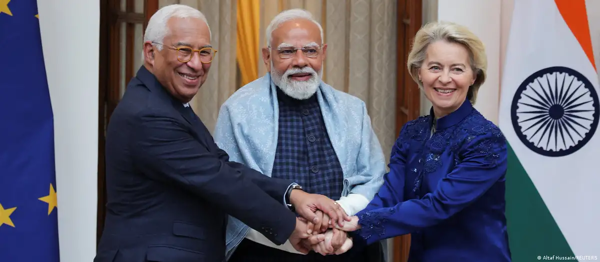
New Delhi, Jan 25 (EFE). - The leadership of the European Union (EU), headed by the President of the Commission, Ursula von der Leyen, and the President of the Council, António Costa, began its official agenda in New Delhi this Sunday with a key meeting with Indian Foreign Minister S. Jaishankar, the first step in a high-level visit that could lead to the signing of a Free Trade Agreement (FTA) on Tuesday.
The visit marks a diplomatic milestone by sending not only the two main community leaders but also much of the EU's institutional leadership, including the High Representative for Foreign Affairs, Kaja Kallas, to the Asian giant. The goal is to seal what von der Leyen has defined as "the mother of all agreements."
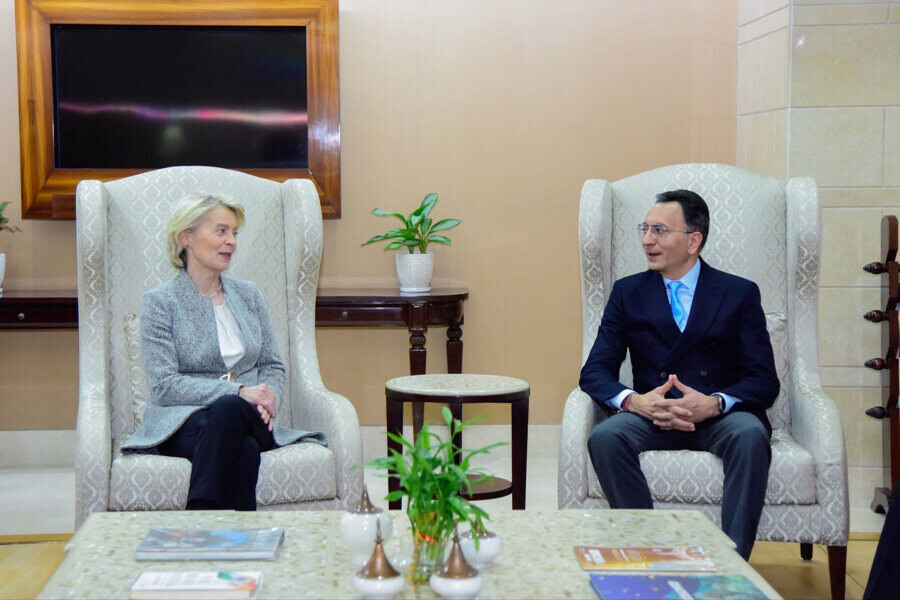
The President of the Commission and the President of the European Council kicked off the events with a joint meeting with the Indian chancellor, a first contact to align positions before tackling the technical and political details of the agreement in the days ahead.
On Monday, the two leaders, accompanied by High Representative Kaja Kallas, will attend as "honored guests" the 77th Republic Day parade alongside Indian Prime Minister Narendra Modi and President Droupadi Murmu. Meanwhile, Kallas will also hold a separate meeting with the Indian Foreign Minister.
The focus will shift to Tuesday, when this high-level delegation will open the 16th India-EU Summit and a meeting between von der Leyen and Prime Minister Narendra Modi will take place.
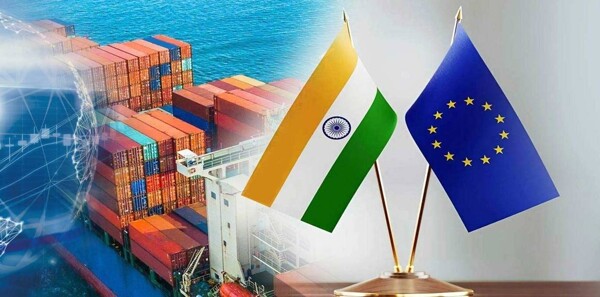
If finally signed, the agreement will end a nearly two-decade diplomatic marathon, marked by disagreements on patent protection, carbon tax, and tariffs on European vehicles and alcohol, and will help Brussels reduce its dependence on China for raw material supplies.
In 2024, India was the EU's ninth-largest trading partner, accounting for only 2.4% of its total goods trade, far behind the 17.3% of the United States or the 14.6% of China.
As part of a renewed strategic alliance to intensify exchange with the Asian country, the roadmap goes beyond the Free Trade Agreement (FTA) itself.
This agreement, whose negotiations date back to 2007 (stalled in 2013 and finally reactivated in 2021), will be complemented by a strong push for investment in cutting-edge sectors such as digital, green hydrogen, solar energy, machinery, and advanced manufacturing, as well as another pact on labor, scientific, and student mobility.
The security agenda will gain importance on Tuesday with the meeting between Kallas and Indian Defense Minister Rajnath Singh, where a second major defense pact to address hybrid threats and terrorism will also be on the table.
With this deployment, the EU and India aim to create one of the world's largest free trade zones, as together they bring together nearly 2 billion people and represent about a quarter of global GDP.